
Review · DARWIN TOURS
Darwin Heritage Walk
Darwin’s story is written in fragments: a century-old theatre here, a cyclone-battered ruin there, and a modern Parliament House looking across the harbor. This small-group walking tour connects those pieces, using the central business district as an open-air history lesson.
I like two things in particular. First, the guides bring strong local knowledge and personal stories, with John, Robin, and Yvonne all singled out for clear, lively commentary. Second, the route shows Darwin’s old and new sides together, including places you might pass without understanding. The main consideration is that this is often as much standing and listening as walking, and one section around the Mall may feel slow if you want constant movement.
Key points to know before booking
- Small groups of up to six: You get a better chance to ask questions and hear the guide clearly.
- A story-led route: The focus is on Darwin’s people, buildings, bombing, Cyclone Tracy, and the city’s survival.
- Six central stops: Star Village, Brown’s Mart Theatre, the Old Town Hall, the Administrator’s buildings, Parliament House, and Bicentennial Park.
- A gentle but warm walk: The pace is easy, but Darwin’s heat makes water, sunscreen, and shade important.
- Best early in your stay: The 8:30 am start gives you useful context for exploring the city afterward.
- A thoughtful caveat: The treatment of Larrakia history and first contact may not be as detailed as some visitors expect.
Darwin’s past behind the modern facades
The best reason to take this walk is simple: Darwin’s central streets can look newer than they really are. Much of the city has been rebuilt, altered, or repaired after major disasters, so the past is not always obvious from the pavement.
A guide helps you read those clues. You’ll hear why certain buildings matter, who used them, and how Darwin grew from a remote northern settlement into the capital of the Northern Territory. The story includes the bombing of Darwin during the Second World War and Cyclone Tracy, the 1974 storm that reshaped the city.
This is not a tour built around grand monuments alone. It is about the people who kept the place going, the buildings that survived, and the everyday corners that preserve older memories. That approach gives the walk its value. You are not simply collecting photographs. You are learning why the photographs matter.
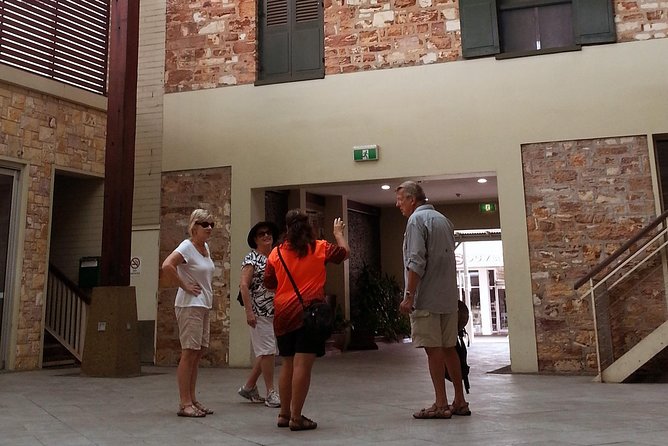
The group size is a real advantage. With a maximum of six people, the guide can usually answer questions without turning the tour into a public speech. John, in particular, is praised for making time for questions, stopping for photographs, and finding shade when the group pauses. Robin is also described as bringing personal experience and strong local stories to the route.
The walk lasts about two to two and a half hours. That is enough time to build a useful picture of Darwin without giving up a full day of sightseeing. Still, the schedule includes several ten-minute stops, so expect regular pauses rather than a brisk march from landmark to landmark.
More history-led days in Darwin:
- Bombing of Darwin WWII Heritage Tours
★ 5.0 · 261 reviews - Darwin History and Wartime Experience Tour
★ 5.0 · 144 reviews - Darwin: Small Group 2-Hour Heritage Walk
★ 4.9 · 28 reviews
Starting at John McDouall Stuart Corner
The tour begins at John McDouall Stuart, at the corner of The Mall and Knuckey Street, in Darwin City. The 8:30 am start is sensible in a tropical city. You will still need a hat, water, sunscreen, and comfortable enclosed shoes, but the early hour should make the outdoor portions easier than a midday walk.
The opening section focuses on Darwin CBD streets and the buildings still connected to the city’s past. This is where the guide sets up the larger story: Darwin has repeatedly had to rebuild, but it has not lost every link to its earlier years.
Expect to spend time listening and looking rather than walking continuously. That suits you if you enjoy context, questions, and anecdotes. If you want a fast overview with only a few short stops, the pace may feel too relaxed.
The route finishes at the intersection of The Esplanade and Knuckey Street, opposite Lyons Cottage. The end point is useful for continuing on foot, although hotel pickup and drop-off are not included.
Star Village and one of Darwin’s older survivors
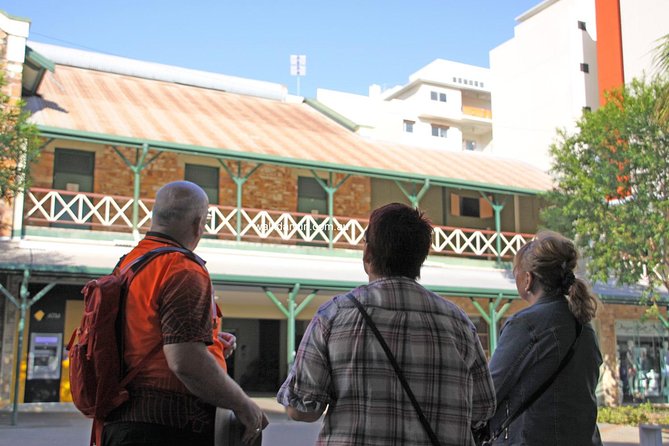
The first named stop is Star Village, with about ten minutes set aside. This former open-air cinema is one of the few original buildings remaining from before Cyclone Tracy.
Today, it has been converted into a stylish retail hub. That contrast is the point. You see a place that has found a new use while retaining clues to its earlier life. The guide explains its old cinema role and draws attention to historic features you could easily miss while browsing the shops.
This is a good early stop because it introduces one of the tour’s main themes: Darwin is not a preserved historic town. Its older buildings often survive by adapting. The result is less visually uniform than an old European center, but it is more revealing of Darwin’s character.
The drawback is that the stop is mainly exterior and brief. You should not expect a museum visit or a long look inside the building. Its value comes from the explanation around it.
Brown’s Mart Theatre and a century of social life
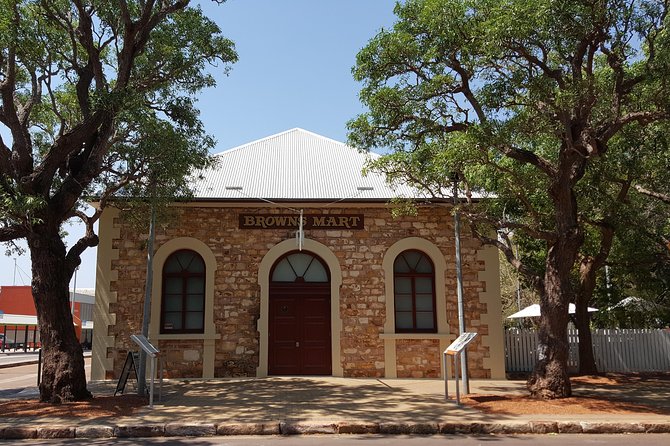
Brown’s Mart Theatre gets another ten-minute stop. The building has been part of Darwin’s social life for more than a century, making it a useful window into the city’s community traditions.
You will mainly view the exterior while the guide fills in the background. The building is important not only because it is old, but because it remained tied to public life through changing eras. That helps you picture Darwin as a lived-in town, not just a remote outpost or a place defined by disasters.
This stop also shows the tour’s balance between architecture and people. The guide does not need a large collection of objects to tell the story. A facade, a street corner, and a few well-chosen anecdotes can explain how the city functioned.
If you prefer entering historic interiors, this may feel limited. The tour’s strength is the commentary, so pay attention to the details rather than expecting a formal building tour.
More walking tours in Darwin:
- Sydney Opera House Official Guided Walking Tour
★ 4.5 · 3,770 reviews - From Sydney: Blue Mountains Tour with Waterfall Walk & Lunch
★ 4.8 · 2,400 reviews - Sydney The Rocks Guided Walking Tour
★ 5.0 · 1,546 reviews - Ultimate Melbourne Walking Tour: History, Laneways & Culture
★ 5.0 · 1,451 reviews
The ruined Old Palmerston Town Hall
The Old Town Hall is perhaps the clearest physical reminder that Darwin’s past has not simply disappeared. Now in ruins, the former Palmerston Town Hall recalls the early town and the pioneers who passed through it.
You get around ten minutes here. The remains offer a strong visual pause in a modern CBD, and the guide uses them to introduce people and events that shaped the town’s early years.
Ruins can be more powerful than restored buildings because they show change plainly. Here, the incomplete structure helps you understand that Darwin’s history includes destruction, rebuilding, and decisions about what to preserve. You are looking at a fragment, but the guide’s stories give it a larger setting.
The tour does not appear to include an extended exploration of the site. Think of this as a focused stop, not an archaeological visit. Its impact depends on the explanation and on your willingness to picture the building in its earlier role.
The Administrator’s buildings and gardens
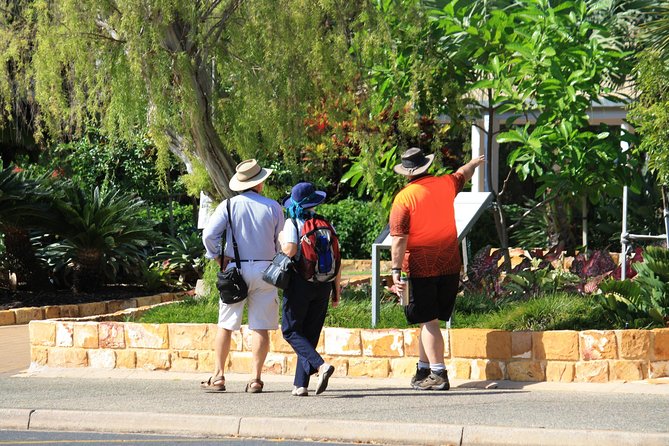
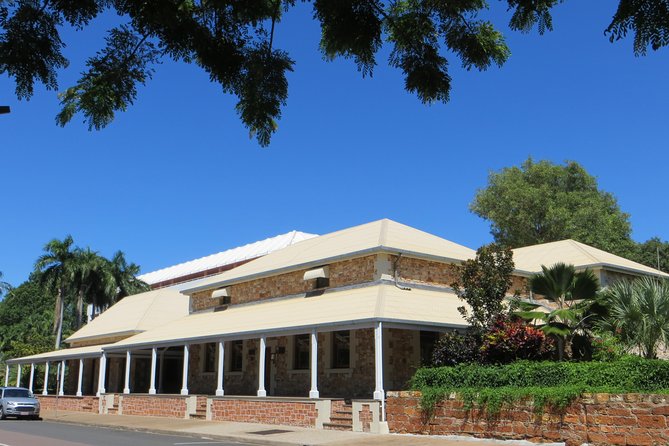
The buildings associated with the Administrator of the Northern Territory provide a different mood. They have been restored, and their gardens represent Darwin’s early years in a more orderly, maintained form.
The stop lasts about ten minutes. Your guide explains how these buildings relate to the administration of the territory and points out details that connect the setting with the city’s first decades.
This is a useful counterpoint to the ruined town hall. One site shows loss and weathering. The other shows restoration and continued official use. Together, they demonstrate how Darwin’s past survives in several forms, from damaged remains to working government buildings.
The buildings are still used as offices, so you should expect to see them from public areas rather than wander freely through every room. That limitation is worth knowing, especially if you are hoping for an indoor heritage tour.
Parliament House and the modern capital
Parliament House marks the shift from early Darwin to the self-governing Northern Territory. The grand building looks across Darwin Harbour and gives the guide a natural place to discuss the modern city’s political identity.
You spend about ten minutes here. The stop is less about decorative detail than about what the building represents. Darwin is not only a town shaped by storms and war. It is also the administrative center of a self-governing territory.
This part will appeal to you if you like knowing how a city operates today, not just what happened long ago. Some commentary can include current affairs and local politics, an aspect that adds practical depth to the historical narrative.
It also helps explain the sharp visual contrast across the route. A modern government building can share the same compact city center with old theatres, ruined civic structures, and surviving colonial-era sites. Darwin’s story is easiest to grasp when you see those layers close together.
Bicentennial Park and the harbor outlook

The final major stop is Bicentennial Park, with about fifteen minutes planned. The park runs along Darwin Harbour and gives you green space, open views, and a quieter setting after the built-up CBD streets.
The park contains reminders of early Darwin, including lesser-known markers and memorial details that connect the open space with the city’s past. The guide uses these features to bring the route together.
This is also the place where the tour’s human stories can carry the most weight. The city’s history includes war, natural disaster, civic ambition, and the persistence of people who kept rebuilding. Looking out across the harbor gives those themes room to breathe.
One point deserves attention here. The route includes Darwin’s heritage, but the commentary may not fully answer every question about Larrakia history, first contact, colonisation, and the treatment of Aboriginal people. If those subjects matter to you, ask directly. The guide may be able to expand the discussion, but you should not assume that the standard presentation will cover them in the detail you want.
That is an important consideration for a modern history tour. Darwin’s story cannot be told honestly through buildings and settler experience alone. The land was not empty before the town developed, and the Larrakia connection is central to understanding the place.
What the guides add to the experience
The guide is the main reason this tour works. The buildings are useful, but several are modest or partly ruined. Their importance comes alive through the person explaining them.
John receives the most repeated praise in the supplied material. He is described as friendly, patient, and able to answer a wide range of questions about Darwin’s history and politics. He also makes the practical side of the walk easier by stopping for photographs and choosing shade when the group pauses.
Robin brings a similar strength, with personal memories and stories from life in Darwin. Yvonne is also praised for making the two-hour route clear and interesting. Guide quality can vary on any small-group experience, but the strongest pattern here is local commitment rather than a memorized script.
The walk is also a good place to ask for suggestions about the rest of your stay. One guide has been praised for recommending local things to do that worked well afterward. I would schedule this early in your Darwin visit so you can use those ideas while you still have time.
Heat, pace, and what to bring
The tour requires moderate physical fitness, but it is not presented as a strenuous hike. The pace is generally easy, with frequent stops and opportunities to sit or stand in shade when conditions allow.
The bigger issue is Darwin’s climate. Bring drinking water, sunscreen, and a hat. Wear enclosed, non-slip walking shoes, especially if surfaces are wet or uneven. Lightweight clothing that suits warm weather will make the two hours more comfortable.
The experience is advertised as operating in all weather, but it can be canceled for poor conditions. If that happens, you are offered another date or a full refund. That policy matters in Darwin, where weather can change quickly.
Children must be accompanied by an adult. Service animals are allowed, and the route is near public transportation. A mobile ticket is provided, so you do not need a printed voucher.
Is $42.32 a fair price?
At $42.32 per person, this is not a bargain-priced stroll, but the small group changes the value calculation. You are paying for a local guide, spoken commentary, two hours or more of attention, and the chance to ask questions at a scale that a large city tour cannot match.
There are no separate admission fees at the listed stops, and food and drinks are not included. Since the route uses public streets, the price is mainly for interpretation rather than access to attractions.
I think the cost is fair if you care about context and want more than a quick orientation. It is less compelling if you plan to walk the CBD independently, take photographs, and read signs at your own pace. The tour earns its keep through stories, especially those about bombing, Cyclone Tracy, local characters, and the city’s repeated recovery.
It is also booked, on average, about 45 days ahead. That does not guarantee every date sells out, but it is a useful warning not to leave it until the last morning of your trip.
Who should book this Darwin walk?
You should book it if you enjoy local history, small groups, questions, and a measured pace. It suits first-time visitors who want a clear introduction to Darwin before exploring museums, parks, and the wider Northern Territory.
It is also a good match for moderately active adults who can walk and stand for two to two and a half hours in warm weather. The route is easy enough for a relaxed morning, but it is not a seated sightseeing tour.
You may want something else if your main interest is Aboriginal history and reconciliation, unless you are prepared to ask direct questions and see how the guide responds. You may also be disappointed if you expect extensive interior access or nonstop walking.
For most people, I would schedule it near the start of a Darwin stay. The route is compact, the guide can help you understand what you are seeing, and the early finish leaves time for more exploring. Book at least 24 hours ahead if you need the free-cancellation option. Cancellations made less than 24 hours before the 8:30 am start are not refunded.
FAQ
How long does the Darwin Heritage Walk last?
The experience lasts approximately two to two and a half hours.
Where does the tour begin?
It begins at John McDouall Stuart, at the corner of The Mall and Knuckey Street in Darwin City, Northern Territory.
Where does the tour finish?
The walk ends at the intersection of The Esplanade and Knuckey Street, opposite Lyons Cottage.
What time does the tour start?
The scheduled start time is 8:30 am.
How many people can join the tour?
The tour has a maximum of six participants. A minimum of two people is required for it to operate.
What should I bring?
Bring a camera, sunscreen, a hat, drinking water, and good enclosed, non-slip walking shoes. Dress for the weather.
Just added around Darwin
- Darwin Combo: The Bombing of Darwin Experience & Darwin Harbour Cruise★ 4.5 · 123 reviews
- Tiwi Islands Cultural Experience from Darwin Including Ferry★ 4.0 · 97 reviews
- Bombing of Darwin World War II Tour with Harbour Cruise★ 4.5 · 219 reviews
- ETHICAL ADVENTURES – 1 Day premium Litchfield tour, small group★ 5.0 · 178 reviews
- Tiwi By Design Day Tour★ 4.5 · 163 reviews
- Litchfield Park & Jumping Crocodile Cruise★ 5.0 · 37 reviews
- Royal Flying Doctor Service Tourist Facility: Two Iconic Territory Stories★ 5.0 · 256 reviews
- 1-Hour Thunderball WWII Adventure Jet Skiing in Darwin★ 5.0 · 70 reviews
Darwin Tours, compared.
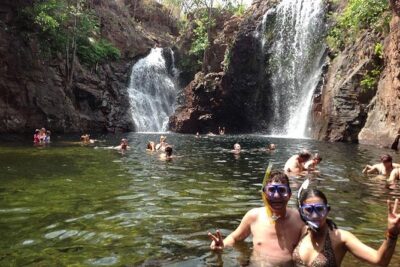
Litchfield National Park and Jumping Crocodile Cruise
Read our review →
Adelaide River Cruises – Jumping Crocodile Experience
Read our review →
Sunset 3-Hour Cruise from Darwin with Dinner and Sparkling Wine
Read our review →
Litchfield Park Tour & Jumping Crocodile Cruise
Read our review →
Kakadu Day Tour from Darwin with Offroad Dreaming
Read our review →
1 Day Corroboree Billabong Wetland Experience including 2.5 hour cruise + lunch
Read our review →Browse the lists this tour appears in